It Is That Deep pt. I
“It’s not that deep.”
”You know what I meant.”
”It’s just a ________.”
”Are we going to have to address this every time something happens?”
”It’s better than the alternative.”
Listen, words mean things, y’all.
You may not know this about me, but I’ve worked in the nonprofit space since the late 2010s. I’ve noticed more than a thing or two that felt antithetical to the mission of organizations trying to “do the right thing.” What are some of those opposing things I’ve witnessed, and more than likely participated in (cringey but real)? I’m glad you asked. Here’s a short list:
Accepting money (philanthropy) from large, values-misaligned corporations
Bypassing inclusivity and input from the communities you serve during the decision-making process. The decisions that directly impact those same communities
Using passive, flattening, offensive, and misdirected language in reference to underserved and marginalized communities
White savior complex
Progress “in theory” and not “in action.”
I could go on and on, but if you know, you know!
For the first edition of It Is That Deep, I’m exploring the connection between what recently happened at the 79th British Academy Film Awards (BAFTA), terms like BIPOC, and virtue signaling.
TL/WR: Language is power, and how we use it reveals who we are and what we value.
Let’s start with the naming of this series, It’s Not That Deep. You’ve probably heard people use this phrase to shut down difficult or “deep” conversations that require curiosity, questioning norms/bias, and more effort than skimming headlines and referencing Artificial Intelligence Overview sections. But language has never been shallow. Even with rising illiteracy rates and declining reading comprehension and attention spans—words still mean things.
The words we choose to describe ourselves, label communities, defend harm, and signal alignment are never neutral—even when we choose to say nothing at all. They reveal what we value, who and what we center, and what we’re willing to overlook for the sake of comfort. Whether it’s in the convenience of terms like “BIPOC,” in the performance of progressive language in the nonprofit and social impact spaces, or in public debates around slurs, disability, intersectionality, censorship, and accountability, the throughline is the same: we treat language like branding when it's actually infrastructure.
Words shape culture and power. If we claim to care about justice, inclusivity, equity, or liberation, then yes—it IS that deep.
BIPOC —The Flattening of the Global Majority
I feel compelled to start on the topic that has been living rent free in my head for some time now… my beef with the umbrella term “BIPOC.”
I will admit, because I like to tell the truth, that I’ve used the term ad nauseam in professional spaces. The girls in corporate love to create acronyms and, in turn, catch all words and phrases because urgency is always afoot, and who can waste time saying entire words, let alone consider if everyone participating in the conversation knows what they mean.
In that spirit, BIPOC stands for Black, Indigenous, and People of Color. A catchy way to flatten anyone belonging to a community who isn’t white. It was created as an update to people of color (POC) to be inclusive of Black and Indigenous people, ensuring all others were represented, especially those with darker skin tones and those who have been historically excluded from more mainstream conversations. With this understanding alone, one (I’m one) could argue that adding two letters (identities) to an existing umbrella term only perpetuates the flattening of numerous communities that don’t reflect the majority in the United States. One could also argue that Black and Indigenous people are the only communities in this catch-all that get a slight shoutout, with most people assuming POC to mean Latino and Asian. As if the term itself wasn’t flattening, its perceived meaning also flattens the experiences of anyone non-white. To use BIPOC when referring to Black women is to assume that Indigenous, Asian, and Latino women have the same/similar experiences without any effort to differentiate or clarify.
You’re not mitigating risk by refusing to name something or someone directly. Terms like these don’t signal progress if your intent is to bypass discomfort, investment, and accountability.
It’s lazy. It’s erasure. And it’s not reflective of reality.
What’s real is that every community flattened in the term BIPOC, makes up the Global Majority— Black, Indigenous, Asian, Latino, and mixed-heritage individuals that make up over 80% of the world population.
What does a switch from BIPOC to Global Majority signify? A shift in power dynamics that decenters whiteness and takes a global approach to identity, rather than the Western lens we tend to use to share language and identity. The term Global Majority still encapsulates solidarity, a value shared among many non-white communities and cultures. Does Global Majority capture every unique experience of each of its members? No. Are we responsible for accurately naming groups of people in language that empowers and honors their unique experience? Yes. As our understanding of ourselves and others evolves, so too does our language. As a living thing, language will take on many shapes and forms with our nurturing and guidance.
When Language Performs — Progressive Spaces & Virtual Signaling
You gotta be real to get deep, and real recognizes virtual signaling from a mile away!
Another vulnerability moment: a part of my work is social media strategy, and I have had an on-and-off relationship with it for the last 10 years. I’ve managed to stay relatively informed and engaged professionally, despite my personal fluctuating relationship. A part of my aversion was the unspoken agreement to perform for followers.
Performing progress, riding the trend, and camouflaging in culture does not make an ally.
My introduction to liberation was through my Black Panther studies. I was introduced to the concept of intersectionality via Kimberlé Crenshaw and my decades-deep existence as a Black woman. Yet words like these, along with equity, anti-racist, decolonize, and countless others, have been co-opted by well-meaning values-driven organizations with insufficient tangible proof that align intent with impact. I want to see impact reports 👏🏾 data-driven strategies👏🏾 case studies 👏🏾 RECEIPTS.
Adding to the list of things I’ve seen in my time working with non-profits and mission-driven companies:
Riding the wave of cultural progress and retreating when the pendulum swings back.
What does this look like? Posting a Black square on Instagram to signal your solidarity with the Black Lives Matter movement, but not having a public anti-racism statement on your website and policies that embed justice, equity, diversity, and inclusion in your hiring practices, fair wages, and supply chain. It can also look like companies that post “standing with [insert victim of state-sanctioned violence]” but not participating in collective action efforts to address local issues and initiatives.
How can you avoid virtue signaling? Building a tolerance of what you don’t know and asking for support. You may have noticed an uptick in the call for community. These are the moments when we call on others to teach us what we don’t know and partner with experts to amplify efforts that provide factual/verified information.
How to spot virtual signaling? Recognizing the pattern with companies that hop on every trend, whether a social justice movement or a pop culture moment. Companies that use justice-focused, human-centered language but never show or talk about their human, governance, and or environmental impact.
Centering community requires shifting decision-making power, bringing in community voices sooner and more often. Equity means diversifying leadership, suppliers, and the collaborators we work with. Being antiracist requires constant practice, and not just statements in our bio. All uncomfortable things to ask for and strive towards, but the necessary, deep work required to talk that radical talk.
I believe in the practice of giving grace. I understand that in the United States, during this current socio-political climate, openly supporting what most would deem radical, like JEDI (justice, diversity, equity, and inclusion) policies, but what we know as the simple, right things to do, could cost contracts, customers, and your bottom line. It takes an immense amount of courage to risk business for what may be happening to communities you don’t belong to. Or that most of us aren’t the founder, C-suite, decision-makers, and have more to lose than to gain by questioning if our organization's actions align with their values. Sometimes all we want to do is make it through the week, do our best, and maybe order in when we’ve had a long day. However, saying the words isn’t the same as doing the work. And if we say them, we should show our work.
Accountability, Intersectional Identities, Landmark Moments and Censorship — the words we don’t say.
I want to start the penultimate section of this piece by acknowledging that the BAFTA incident involving repetitive racial slurs, censorship, disability, and accountability is a multi-layered, uncomfortable topic to discuss publicly, particularly through the lens of seeking justice.
For those who are unfamiliar, recently, at the BAFTAs, Sinners stars Michael B. Jordan and Delroy Lindo were onstage presenting an award for visual effects. John Davidson, a Tourette’s campaigner whose story with the condition was told through the BAFTA-nominated film I Swear, hurled “n_____r” several times, which was clearly audible in the broadcast. The same broadcast, hosted by the BBC, did not edit the racial slur out of the programming but did edit down Nigerian-British filmmaker Akinola Davies Jr.'s acceptance speech for their win in Outstanding Debut Film for My Father’s Shadow. Davies Jr.’s acceptance speech, including “free Palestine, Nigeria, Sudan, and Congo,” which did not make it into the broadcast.
At the time of this writing, BAFTA has issued a public written apology stating: "Our guests heard very offensive language that carries incomparable trauma and pain for so many. We want to acknowledge the harm this has caused, address what happened, and apologize to all." The apology goes on to say, "During the ceremony, John chose to leave the auditorium and watch the rest of the ceremony from a screen, and we would like to thank him for his dignity and consideration of others, on what should have been a night of celebration for him."
The BBC has also issued a statement stating: "We apologise that this was not edited out prior to broadcast and it will now be removed from the version on BBC iPlayer."
During the ceremony, BAFTA’s host, Alan Cumming shared, “You may have noticed some strong language in the background,” with live attendees and viewers around the world. “Thanks for your understanding and for helping create a respectful space for everyone.”
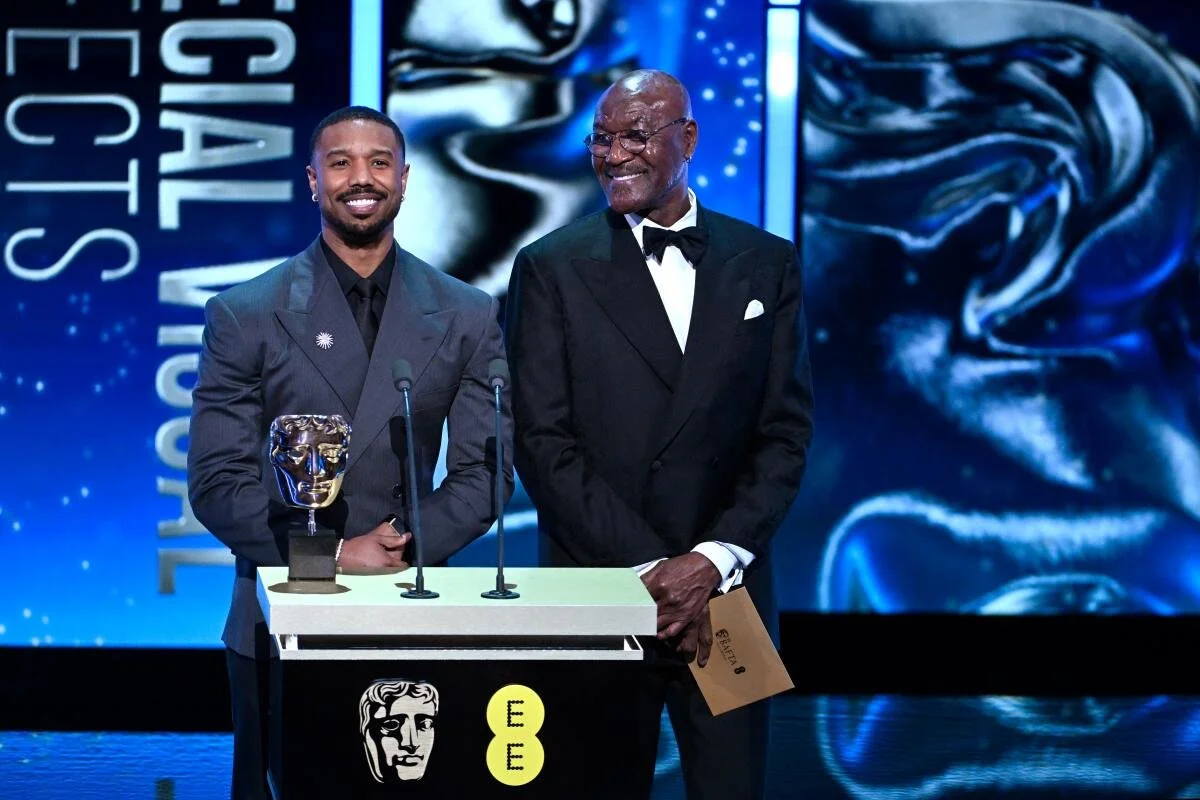
Are you noticing a trend here? In none of the above public statements has anyone addressed all those who were specifically harmed: Jordan, Lindo, Black attendees, and Black viewers. While the harm was done in person, the BBC made a grave mistake by allowing the slur to be televised and shared ceaselessly over the last few days. The BAFTAs and the BBC took the opportunity to educate readers about Tourette’s Syndrome, and took their time to update those who had been waiting for an acknowledgement and apology for the actions Davidson took after the harm was already done. We have yet to hear from Davidson or his representation*. In an interview, Delroy Lindo shared with Vanity Fair that both he and Jordan “did what we had to do” in that moment for which the BAFTAs thanked them both for their “professionalism and dignity.”
Moments like these highlight the long road ahead to bake diversity, equity, and inclusion into company practices, policies, and systems. While I’ve seen many understand and offer grace to Davidson for how his involuntary tics manifested during the event, there is a desire for accountability even among those living with disabilities. Situations like these that commend Davidson for his professionalism and dignity also call into question whether the same grace is held for members of the Global Majority who also live with disabilities. Perhaps we revisit the tragic stories of Sonya Massey and Elijah McClain for comparison.
What would have been inclusive would have been inviting Davidson to the awards and preparing and offering accommodations that considered his disability and the potential risks to him, attendees, and viewers. Because this didn’t happen, the next best step would be the obvious: editing the broadcast to remove the slur, immediately issuing an apology to Jordan, Lindo, and attendees, and immediately getting to work internally on mitigating risk going forward based on this incident. But perhaps this required them to admit they messed up. I imagine it would also cause great discomfort to have to explain their censorship edits instead. And it may have ultimately ended with them asking for help in supporting those with disabilities so all honorees and attendees feel safe, honored, and welcome.
The BAFTAs aren’t a separate issue from using flattening terms like BIPOC or the pervasive issue of virtue signaling. When we flatten language, we erase specificity. When we perform language, we coat our reputations with flimsy protection. And when harmful language happens, we reveal what we value, and in this case, it was reputation and comfort, not accountability.
Words Mean Things.
Words Mean Things.
I could drop the mic there, but I want to leave you with a few things to think about—perhaps a personal audit of how you show up at work, in your relationships, and in what you value.
Invitation to Rethink How We Use Words:
What words are you swapping out of your vocabulary and why?
Who and what disappears when you opt for convenience?
Where are you using language as shorthand instead of truth?
Do my values come through more in my narrative or in my decisions?
Am I using language to signal belonging? Or to practice accountability?
When harm happens, do I focus more on intent or impact?
Who has the authority to define what a word “really” means?
Are we as rigorous about our language as we are about branding?
Where have we mistaken inclusion language for inclusion itself?
What would it look like to retire language that no longer serves truth?
Come back and visit me Dwntwn next season for a deep dive into all the things that really are THAT deep. We’re going there!
With Ease,
Lauren